
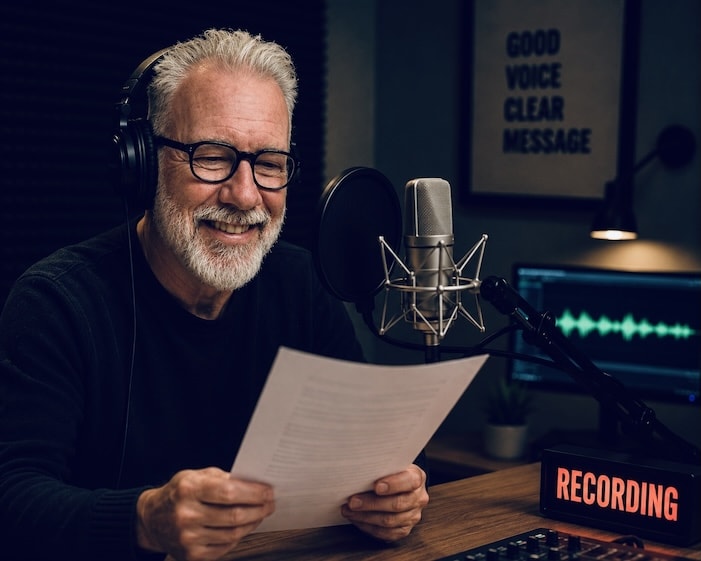
It’s been a strange few years in the world of professional voiceover.
For many human voiceover artists, voice actors, and narrators – most of us working alone from home studios and soundproofed booths talking to ourselves for a living – the rise of AI-generated voices has felt somewhere between mildly unsettling and absolutely terrifying.
The entire industry has been built around human performance. Successful careers in professional narration, documentary voiceover, and commercial voice acting all depended on storytelling and emotional connection.
And then overnight, the internet was awash with cloned voices, synthetic narration and AI-generated content appearing at breakneck speed.
It felt pretty bleak to see the world apparently sprinting toward this new version of voiceover, without a second thought for the most superficial of reasons.
Faster.
Cheaper.
Minimal effort required.
So many businesses and creative industries seemed completely captivated by the novelty of it all.
And for a while there, I – and the voiceover industry in general – began to question whether anyone would truly see the value of our human voices again.
Until recently.
You can read more of my thoughts on the rise of AI in my blog, AI vs the Human Voice: A Considered View from the Booth.
The backlash against AI-generated voices
It seems as though the tides might just be turning. There is a growing wave of dissent and dissatisfaction slowly surrounding the surge of AI slop flooding the internet and the airwaves. It’s not just some Luddite-like revolt against technology itself, you understand – rather the dawning realisation of what has been lost.
No one is disputing that AI-generated narration is technically advanced. Everyone is suitably impressed by the rapid rise of programmable robotic capabilities.
But audiences have started to realise that great voiceover has never been simply about reading words out loud, however fast and cheap it might be.
Particularly in my own little corner of the voiceover world, where documentary narration, audiobook narration, corporate voiceover and commercial storytelling have long been rooted in the emotion, nuance and life experience of a human voice.
AI can blandly communicate information.
But a great human voiceover makes you feel something.
Human narration creates real emotional connection
Some voices don’t just ring a bell. They ring the whole belfry.
A couple of syllables in, and your brain instantly transports you somewhere else.
David Attenborough can say a handful of words, and suddenly you’re standing in the Arctic watching penguins huddle together against the cold.
Stephen Fry starts narrating an audiobook, and half the nation collectively relaxes by about 12%.
That’s the magical thing about human narration.
We don’t simply hear voices – we feel them.
They are bound to emotions, memories and moments in our lives.
Documentary voiceover, audiobook narration and long-form storytelling work precisely because of this.
A human voiceover brings warmth, personality, emotional nuance and the kind of empathy that only comes from lived experience.
The voice becomes part of the story.
It’s one of the reasons those old adverts we heard decades ago still linger in our brains – despite not remembering what we had for breakfast this morning.
Voices take us back in the blink of an eye.
To Sunday evenings, listening to our favourite Radio 1 DJ doing the chart show.
To car journeys and the soundtrack of the M5. Insert motorway of choice here.
To whichever earworm advert was part of our formative years, from Shake n’ Vac to Cadbury’s Caramel.
To the audiobook that got you through that tough time last year.
It’s the reason why professional voiceover still absolutely matters for brands, documentaries, gaming, corporate narration, commercials and storytelling today.
Because, the thing that makes a voice stay with us is human connection.
AI slop and the loss of human connection
The problem is not actually the existence of AI. Or even some of the AI tools used in voiceover (much as it pains me to say it).
It’s the sheer volume of it.
Synthetic narration is everywhere. Social media. Advertising. Video content. Audiobooks. Explainers. Corporate content.
At the touch of a button, that same slightly soulless digital drone can be heard on what seems like every channel.
And people have started noticing.
Questioning.
Raising their voices to challenge the relentless output of polished, personality-less voice simulation – for many reasons.
Initially, there was a sense of something missing.
Everything is too polished. Too clean. Too generic. And unsettlingly lifeless.
The thing that’s missing?
Those perfect imperfections of a human voice that make it at once powerful and instantly recognisable.
As we’ve established – great narration isn’t just the sounds of the words on the page – it’s how the script is interpreted by a professional voiceover artist.
Particularly in documentary narration, audiobook voiceover and commercial storytelling, the true skill lies in the things audiences barely notice consciously.
The pause in the right place.
The slight warmth in a line.
The restraint not to overcook a section of speech.
And in an unexpected turn of events, it may perhaps be the relentless rise of AI itself that makes us realise what we’re missing.
The ethics of AI voice cloning
And then, of course, there’s the ethics – or lack thereof – around AI voice generation.
This is where we move beyond unease about quality, or worry about the impact on the voiceover industry, and into something far more serious: outrage at the invasion of privacy, abuse of identity and intellectual property.
This is no longer just a criticism about the beige tones of synthetic narration, or the quality of an AI voiceover churning out a training video before you’ve finished your sandwich.
This is about consent. Ownership. Permission.
The big, important stuff that’s being trampled on every single day.
Professional voice actors discovering cloned versions of their voices online without agreeing to it.
Deceased artists having their voices recreated by AI systems years after their deaths.
Entire performances replicated without consent.
It seems like an astonishing series of sentences to type.
Or it would be, if it were purely theoretical territory for me.
Which, alas, it is not, as my own voice was cloned some years ago.
I speak from experience, and from the heart when I say that a voice isn’t simply data to be copied, scraped and sold.
It’s somebody’s livelihood.
Their personality.
Their experience.
Their identity.
All the quirks, pauses, instincts, and aforementioned perfectly imperfect human details that make a voice recognisable in the first place.
The things that create that human connection.
And ultimately, what still makes human voiceovers matter so very much.
Documentary narration – and why human voices still matter
Documentary narration works best with a voice that knows when to lead and when to take a subtle step back.
A professional documentary voiceover artist helps audiences connect emotionally with the story – but never overpowers it. Whether it’s nature documentaries, factual programming or long-form storytelling, human narration brings warmth, trust and emotional nuance that synthetic voices will always struggle to replicate.
The best documentary voiceovers may guide you – but they never distract you from the story itself.
Why human corporate voiceover still matters
Corporate narration and business voiceover often deal with complex subjects, from technology and finance to healthcare and training content.
One of the greatest skills a professional corporate voiceover artist can bring to a recording session is the ability to make that information feel engaging, clear and human.
Because even in business communication, people still respond to personality, warmth and trust.
Read more about this in my blog, What makes a Good Corporate Voiceover.
Human connection in e-learning narration
E-learning voiceover is about far more than simply reading information clearly.
The best professional narration keeps learners engaged – sometimes over long periods of time – while helping information feel accessible and easy to understand, rather than monotonous or emotionally flat.
A human voiceover brings conversational energy and warmth that makes training content easier to absorb and easier to remember.
Because some things never change – and learning still works best when it feels human.
Commercial voiceover and emotional storytelling
Contrary to popular opinion, the best commercial voiceover doesn’t simply sell products.
It creates atmosphere. Feeling. Emotional connection.
Whether it’s television advertising, radio commercials or online campaigns, audiences instinctively respond to authentic human storytelling and believable performances.
In many ways, that’s often the difference between a brand being remembered or disappearing forever into the advertising abyss.
Explainer video voiceover that connects
Explainer videos succeed when complicated ideas feel simple.
A professional explainer voiceover artist helps brands communicate clearly while still sounding natural and conversational rather than robotic or scripted.
In fact, the sign of a great explainer voiceover is the ability to make even the most technical information sound like it’s coming from a real human being.
Why human voiceover still matters
Ironically, AI may end up reminding people why authentic human voiceover mattered so much in the first place.
Because the more artificial and synthetic everything around us becomes, the more we begin to value what we realise we are losing.
Real voices.
Real storytelling.
Real emotional connection.
And despite the rise of AI, the ethical concerns and the uncertainty the industry has faced in recent years, I genuinely believe we are starting to see the beginning of change.
Not the end of AI – that’s clearly here to stay.
But the return of real value in the human voice, in the places where it matters most.
If you’re looking for an authentic British voiceover actor for documentary narration, corporate voiceover, e-learning, commercial storytelling or explainer video content, feel free to get in touch.
Human voice guaranteed.
