
Most of my professional life has involved explaining things clearly.
Selling something.
Telling listeners how something works.
Reassuring someone.
Guiding an audience calmly from A to B.
Gaming, however, has required me to interrogate heretics, command genetically enhanced super-soldiers, whisper conspiracies, shout battle cries, and ride across 13th century Mongolia delivering diplomatic messages.
It’s fair to say the job description has broadened.
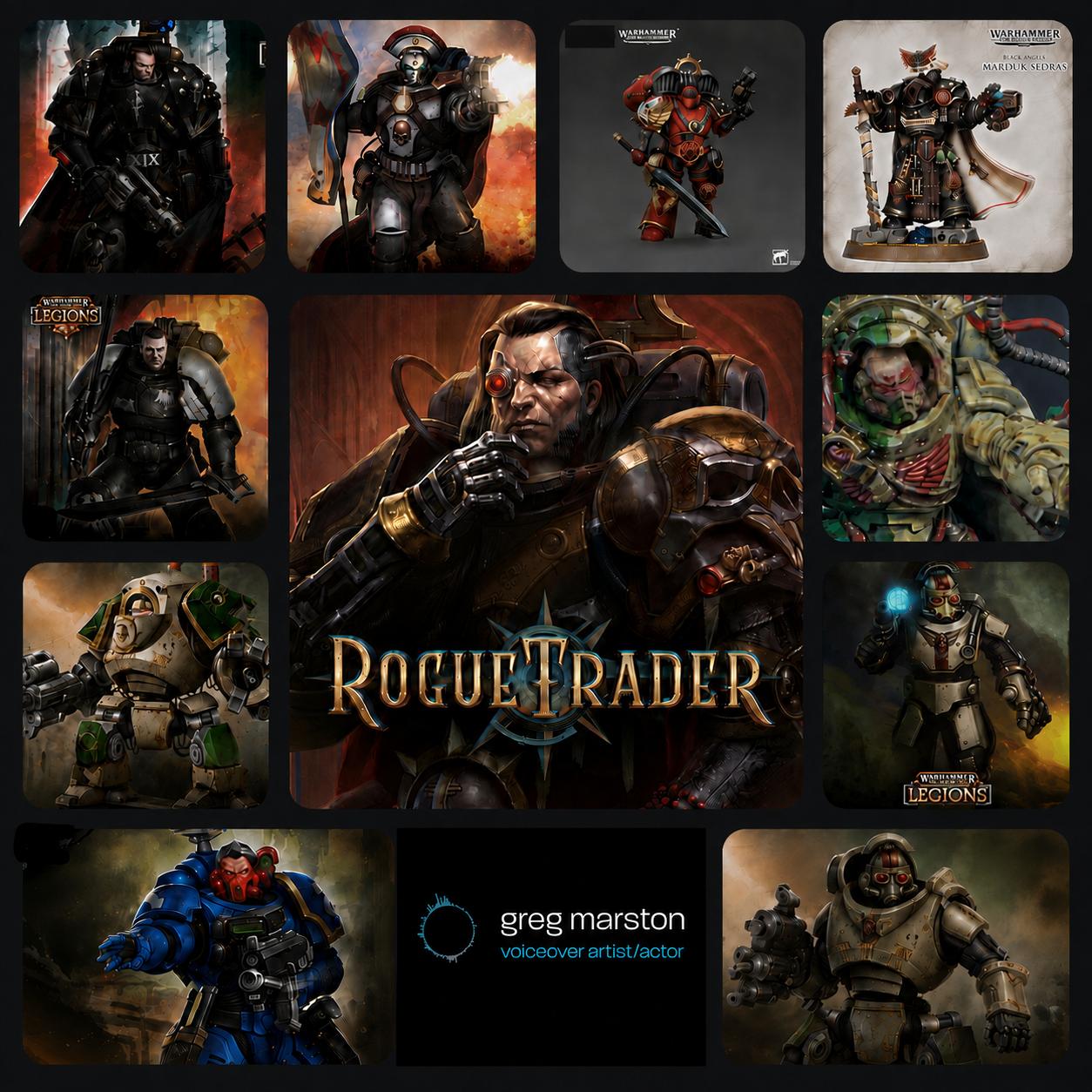
Alongside my more ‘commercial’ work, I’ve become ‘the voice’ of several characters across the Warhammer 40K universes – including Rogue Trader, Horus Heresy and Legions. In Rogue Trader, I play one of the principal interactive characters: The Inquisitor, Xavier Calcazar.
Quite how all these vast and intersecting ‘universes’ function is something I’ll happily leave to the devoted and far more knowledgeable fan base. What I do understand is this: when you step into an established world with a deeply invested audience, you have a responsibility to serve it properly.
And that’s where gaming voice work becomes something rather different from commercial narration.
Commercial voice vs character performance
Commercial and corporate voice-over is about clarity, control and precision.
You are delivering a message.
You are representing a brand.
You are guiding the listener’s attention with intention and restraint.
Even when there is warmth or drama involved, it is contained. Measured. Focused.
Gaming voice acting, by contrast, is performance in a far more expansive sense.
You may be recording dialogue trees with multiple emotional variations of the same line:
- Calm authority
- Controlled menace
- Barely concealed fury
- Outright rage
All in succession.
You may be delivering hundreds of lines across sessions recorded weeks or months apart. You may not always have the full narrative context. Scenes are often recorded out of sequence. A character’s emotional arc has to be sustained even when the timeline is fragmented.
And then there are the efforts.
Battle cries.
Impacts.
Injuries.
Breath.
Death.
It is, in short, rather more physical than reading a corporate script about quarterly performance.
Entering established universes
Voicing characters in the Warhammer 40K world has been an education.
In Rogue Trader, Xavier Calcazar is not a passing presence. He interacts with the player. He influences outcomes. He carries weight within the story.
Elsewhere, I’ve voiced characters such as Zephon in Legions: Dominion, Kaedes Nex in Horus Heresy, Marduk Sedras, Valius Paxor, Serob Karful, Nykona, Sharrowkyn, and a number of other soldiers, captains, and assorted NPCs (non-playing characters).
An NPC, for those less immersed in gaming terminology, is any character controlled by the game rather than the player. Minor role or not, each one contributes to the credibility of the world. If even a small part feels false, the illusion weakens.
What struck me most was the intensity of the audience’s investment. These characters are not background noise. They matter deeply to the people playing the game. The performance has to feel authentic within that established tone and lore.
No pressure.
From Grimdark to the Mongolian Steppe
If voicing an Imperial Inquisitor represents one end of the tonal spectrum, my more recent work as Batu in Windstorm: The Legend of Khiimori occupies another entirely.
Set in 13th century Mongolia, the game places players in the role of a courier navigating vast landscapes, managing resources, forming bonds with horses and surviving harsh terrain. Batu is not commanding space marines; he is navigating responsibility, environment and survival.
The vocal energy required is very different. Less operatic menace. More grounded resolve. Quieter moments of reflection. Human vulnerability.
That contrast – from dystopian sci-fi intensity to historical open-world realism – is precisely what makes gaming work so absorbing. The setting changes. The vocal colour shifts. The craft, however, remains the same: commit to the truth of the character.
The physical reality of gaming sessions
There is a persistent myth that voice actors exist in a state of permanent vocal pampering.
Steam inhalation.
Herbal infusions.
Elaborate warm-up rituals involving scales and mysterious lozenges.
I feel I should confess that I have never subscribed to any particular regime.
No lemon and honey.
No chanting.
No ritualistic throat-steaming apparatus.
And yet, somehow, the voice has continued to turn up for work.
That said, gaming sessions do require stamina. Recording sustained combat efforts or intense emotional exchanges demands control. It is not about shouting indiscriminately; it is about producing the sound safely and consistently. Pace, breath support and technique matter more than theatrics.
The aim is always repeatability. If a line needs to be matched weeks, months, or even years later, it must sound as though no time has passed at all.
The practicalities of booking and preparing for voice work are often less glamorous than the performance itself.
A lifelong habit of ‘funny voices’
Although I have provided character voices throughout my career, it’s not something I’ve ever described as a particular strength – and therefore not something I’ve actively advertised.
That said, ever since I can remember, I’ve enjoyed doing ‘funny voices’, occasionally attempting to mimic famous people or characters, and absorbing the influence of the comedians who shaped my teens and twenties. (Monty Python… but I’ll resist the temptation.)
Voicing these gaming characters therefore feels like the icing on what has otherwise been a fairly straightforward cake.
It allows space for imagination within a professional framework.
What game studios need from a voice actors
From a studio’s perspective, gaming voice work is not simply about vocal range. As ever, it begins with a clear briefand a shared understanding of what the role requires:
- Emotional authenticity
- Consistency across extended recording sessions
- The ability to take direction quickly and adapt
- Technical reliability and broadcast-quality recording
- Respect for deadlines and delivery specifications
A compelling character performance is built on discipline as much as creativity.
Whether voicing a central protagonist or a minor NPC, the responsibility is the same: serve the story, support the design, and contribute to the integrity of the world being built.
The craft is the constant
From commercial narration to inquisitors, overlords, soldiers and 13th century couriers, the scenery shifts.
The responsibility does not.
My task remains the same: understand what’s required, deliver it honestly, and make certain the performance supports the narrative rather than competes with it.
If you are casting for a video game and require a British voice actor with experience across both commercial and character work, you can hear a range of styles on the ‘Hear’ page of this website, or get in touch directly to discuss your project.
I promise not to arrive armed with a steamer.
Frequently Asked Questions
What does a video game voice actor do?
A video game voice actor performs the spoken dialogue for characters within a game. This can include main protagonists, villains, supporting roles and NPCs (non-playing characters). The work often involves recording dialogue trees, emotional variations, combat efforts, reactions and scene-specific performances, sometimes without full narrative context.
How is gaming voice acting different from commercial and corporate voice-over work?
Commercial and corporate voice-over focuses primarily on clarity, brand representation and message delivery. Gaming voice acting requires sustained character performance, emotional range, physical effort sounds, and the ability to maintain consistency across long recording sessions. It is usually more theatrical and physically demanding than corporate narration.
What is an NPC voice actor?
An NPC voice actor provides the voice for a non-playing character – a character controlled by the game rather than the player. While some NPC roles may be brief, they are essential to building a believable and immersive game world.
Can a British voice actor record remotely for game studios?
Yes. Many professional voice actors operate from broadcast-quality home studios and regularly work with international game developers. Sessions can be directed remotely via industry-standard platforms, with high-resolution audio delivered securely and efficiently.
What should game studios look for when hiring a video game voice actor?
Studios should look for emotional authenticity, vocal stamina, consistency across sessions, technical recording quality and the ability to take direction quickly. Experience in both commercial and character work can also provide valuable versatility when developing complex roles.
